
Leonard Victor Finch
Leonard Victor Finch was born on 28 April 1904 at 17 Embankment Terrace, Bridge Road, Chelmsford, in what was then the Chelmsford Urban District of Essex. His birth was registered by his mother, Alice Finch (née Bonnington), on 6 June 1904.
The official birth certificate records his father, William John Finch, as a Market Gardener (Master), indicating that he was more than simply an agricultural labourer and likely managed his own gardening business or employed others. Earlier census records from 1891 and 1901 describe William as a gardener, a trade that would support his growing family throughout Leonard's early years.
Leonard arrived as the youngest of nine children, joining a family that had already experienced both joy and tragedy. By the time of his birth, his parents had spent more than twenty years building their family in Chelmsford. His older brothers and sisters ranged from young adults beginning their working lives to school-aged children, making Leonard very much the baby of the family.
His birth also marked the end of a generation. Of his four grandparents, only one was still alive when Leonard was born. His maternal grandfather, William Alfred Redger Bonnington, survived to see the birth of his youngest grandson and represented Leonard's last direct link to an older Victorian generation.
The other grandparents had all passed away before Leonard's birth. His maternal grandmother, Harriett Fitch (1839–1875), had died nearly three decades earlier. On his father's side, his grandfather Robert Finch (1808–1879) and grandmother Elizabeth Blackfall (1810–1888) had also died many years before Leonard's birth.
When Leonard was born, Britain was entering a new century under King Edward VII. Chelmsford was a busy market town undergoing rapid change, with new industries, expanding housing, and improved transport links transforming daily life. Yet the Finch family remained rooted in the traditions of working-class Victorian England, centred around family, church, and the seasonal rhythms of William's gardening trade.

| Field | Transcription |
|---|---|
| Entry No. | 304 |
| When and Where Born | Twenty-eighth April 1904 17 Embankment Terrace, Bridge Road, Chelmsford U.D. |
| Name | Leonard Victor |
| Sex | Boy |
| Father | William John Finch |
| Mother | Alice Finch formerly Bonnington |
| Rank or Profession of Father | Market Gardener (Master) |
| Signature, Description and Residence of Informant | Alice Finch Mother 17 Embankment Terrace, Bridge Road, Chelmsford |
| When Registered | Sixth June 1904 |
| Signature of Registrar | W. Pear (or possibly Wear) |
The Finch family in 1904:

Father
William John Finch
(1847 - 1907)

Mother
Alice Bonnington
(1862 - 1917)
Son
William Finch
(1885 - 1962)
Son
Arthur James Finch
(1886 - 1952)
Son
Harry Finch
(1888 - 1916)
Son
Frederick Charles Finch
(1890 - 1901)
Daughter
Alice Ethel Finch
(1893 - )
Son
George Ernest Finch
(1895 - 1970)
Daughter
Emily Beatrice Finch
(1898 - 1983 )
Daughter
Christina Mabel Finch
(1902 - 2005 )
Son
Leonard Victor Finch
(1904 - 1972)
Baptism
Just over a month after his birth, Leonard Victor Finch was baptised on 8 June 1904 at St John the Evangelist Church, Moulsham, in Chelmsford, Essex.
The baptism marked Leonard's formal entry into the life of the Church and was an important event for many Edwardian families. At the time, baptism was not only a religious ceremony but also a significant social occasion, often attended by parents, siblings, relatives, and close friends. For the Finch family, who had lived in the Moulsham area for many years, St John's would have been a familiar and important part of community life.
Chelmsford in the 1900s
By the beginning of the 20th century, Chelmsford had a population of almost 22,000 (181,000 in 2023). And it continued to grow rapidly (partly due to boundary extensions). Meanwhile, amenities in the town improved. A library opened in 1906 and before the First World War, the first cinemas opened.
Death of William John Finch
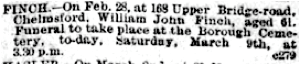
Less than three years after Leonard's birth, the Finch family suffered a significant loss. On 28 February 1907, Leonard's father, William John Finch, died at the family home at 168 Upper Bridge Road, Chelmsford. He was 58 years old.
His death certificate records his occupation as a "Jobbing Gardener", while Leonard's birth certificate, issued less than three years earlier, described him as a "Market Gardener (Master)". Together, these records suggest that William spent his working life in horticulture and gardening, either working for various clients or cultivating produce for sale in the local area.
The cause of death was recorded as Diabetes Insipidus and Cardiac Failure, with the death certified by Dr A. D. Stone. The informant was William's son, Arthur James Finch, then aged 20, who was present at his father's death and registered it the following day.
At the time of William's death, his wife Alice Finch had no recorded occupation. Their two eldest surviving sons, William Finch and Arthur James Finch, were still establishing themselves in their trades and serving apprenticeships. The remaining children, including Leonard, were still of school age. It is therefore likely that William had been the family's principal source of income, making his death not only a personal tragedy but also a significant financial blow to a household with several dependent children.

| Field | Transcription |
|---|---|
| Entry No. | 181 |
| When and Where Died | Twenty-eighth February 1907 168 Upper Bridge Road, Chelmsford U.D. |
| Name and Surname | William John Finch |
| Sex | Male |
| Age | 58 Years |
| Occupation | A Jobbing Gardener |
| Cause of Death | Diabetes insipidus Cardiac failure Certified by A. D. Stone, M.B., B.C. |
| Signature, Description and Residence of Informant | Arthur Finch Son Present at the death 168 Upper Bridge Road, Chelmsford |
| When Registered | First March 1907 |
| Signature of Registrar | W. Pear (or possibly Wear – the handwriting is slightly unclear) |
The 1911 Cencus
The Finch household

168 Upper Bridge Road has been renumbered and the house is now 175 Upper Bridge Road.
| Name | Age | Occupation |
|---|---|---|
| Alice Finch | 49 | No occupation recorded |
| William Finch | 26 | Engineer's Labourer (Wireless Telegraphy) |
| Arthur James Finch | 24 | Engineer Turner |
| George Ernest Finch | 16 | Wood Box Maker |
| Emily Beatrice Finch | 13 | School |
| Christina Mabel Finch | 8 | School |
| Leonard Victor Finch | 6 | School |
Alice Ethel Finch

By 1911, Ethel Alice Finch had left the family home in Chelmsford and was working as a domestic servant at The Homestead, Writtle, Essex.
The census records her as 18 years old, single, and employed as a servant/domestic in the household of Ernest Edwin Shead, a 38-year-old corn dealer. Also living in the house were Ernest’s wife, Edith, their children Wilfred and Phyllis, and another young woman, Marion C. Shead, aged 16.
Ethel’s birthplace is recorded as Chelmsford, Essex, linking her clearly back to the Finch family at Upper Bridge Road. Her presence in Writtle shows that, by her late teens, she had entered service — a common path for young working-class women at the time. Domestic service offered employment, board, and lodging, but it also meant living away from home and working within another family’s household.
Harry Finch
The 1911 Census found Harry Finch, Leonard's older brother, serving in the Royal Navy at the age of 22. Rather than appearing in a household census return, Harry was recorded aboard a Royal Navy vessel as part of a list of officers and crew.
The census entry records Harry as:
| Name | Age | Marital Status | Rank / Branch |
|---|---|---|---|
| Harry Finch | 22 | Single | Stoker, Engine Room |
As a Stoker, Harry worked below deck in the ship's engine room. The role was physically demanding, involving the operation and maintenance of the boilers that powered the vessel. In the era before oil-fired ships became common, stokers were responsible for shovelling coal into furnaces, maintaining steam pressure, and ensuring the engines operated efficiently. The work was hot, dirty, and exhausting, often carried out in temperatures that could exceed those experienced on deck by a considerable margin.
Harry's decision to join the Royal Navy offered opportunities that would have been difficult to find in Chelmsford. The Navy provided regular pay, accommodation, training, and the chance to travel throughout Britain and beyond. For many young men from working-class families, naval service represented both employment and adventure.
His census return places him amongst a crew drawn from across the United Kingdom, including men from London, Kent, Yorkshire, Ireland, Scotland, and Northumberland. Although hundreds of miles from home, Harry remained one of many young sailors whose lives revolved around the demanding routine of naval service.

The Great War (WWI)
Beginning in July of 1914 the First World War was thought that the War would only last a few weeks. However, the war would go on until November 1918 and see 20 million deaths and 21 million injured.
In January of 1916 the Military Service Act was passed. This imposed conscription on all single men aged between 18 and 41, but exempted the medically unfit, clergymen, teachers and certain classes of industrial workers.
Marriage William Finch
On the 4th of August, 1913 William Finch married Beatrice Alice Bartlett at St Paul, Bournemouth, Hampshire. Beatrice was born in Sherborne, Dorset.
Marriage Arthur James Finch
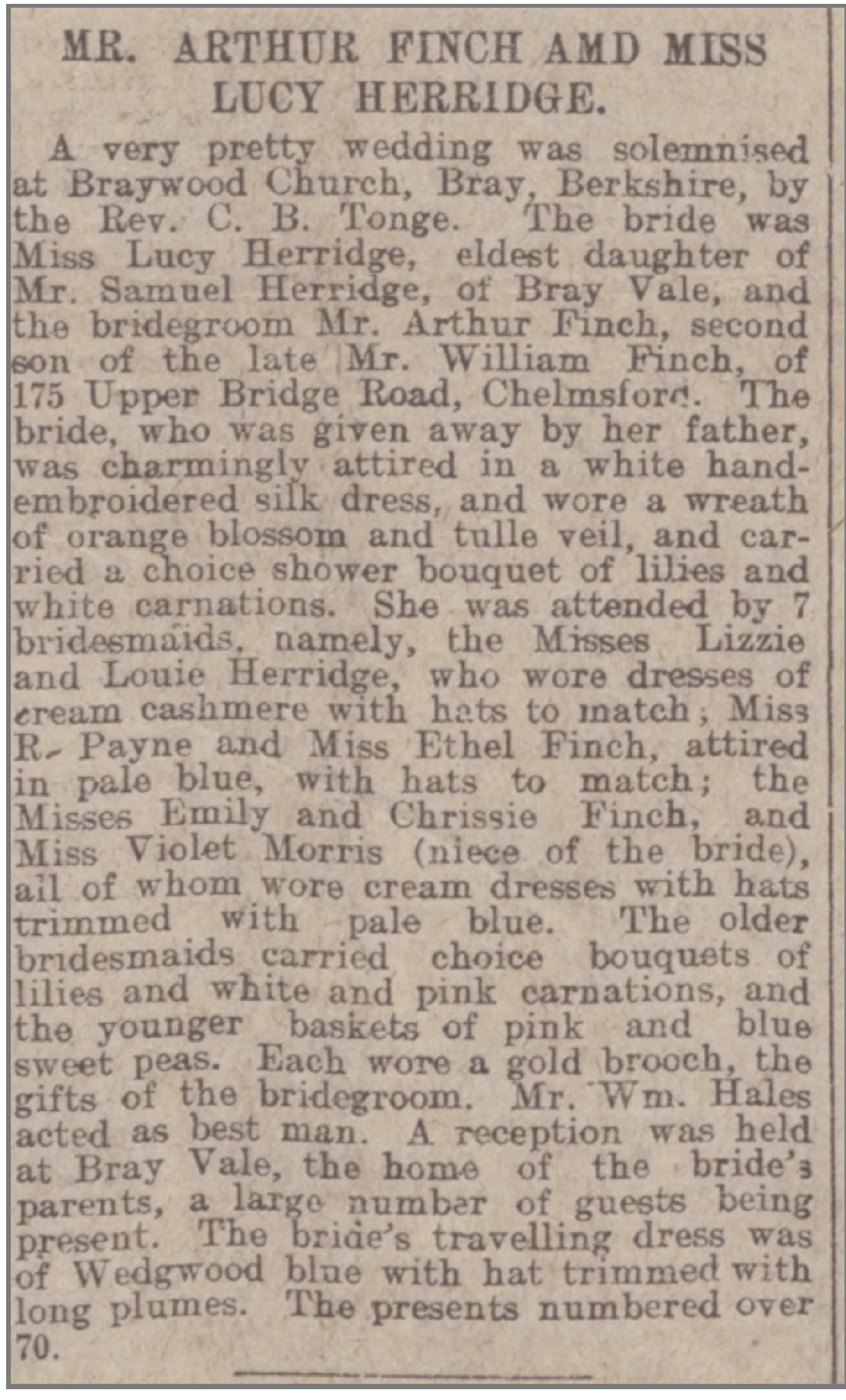
On the 23rd of July 1913, Arthur James Finch married Lucy Alice Herridge in Maidenhead, Berkshire. From her birth and census records Lucy Herridge had lived in the Maidenhead area her whole life.
Essex Newsman Herald 02/08/1913
MR. ARTHUR FINCH AND MISS LUCY HERRIDGE.
A very pretty wedding was solemnised at Braywood Church, Bray, Berkshire, by the Rev. C. B. Tonge. The bride was Miss Lucy Herridge, eldest daughter of Mr. Samuel Herridge, of Bray Vale, and the bridegroom Mr. Arthur Finch, second son of the late Mr. William Finch, of 175 Upper Bridge Road, Chelmsford.
The bride, who was given away by her father, was charmingly attired in a white hand-embroidered silk dress, and wore a wreath of orange blossom and tulle veil, and carried a choice shower bouquet of lilies and white carnations.
She was attended by 7 bridesmaids, namely, the Misses Lizzie and Louie Herridge, who wore dresses of cream cashmere with hats to match; Miss R. Payne and Miss Ethel Finch, attired in pale blue, with hats to match; the Misses Emily and Chrissie Finch, and Miss Violet Morris, niece of the bride, all of whom wore cream dresses with hats trimmed with pale blue.
The older bridesmaids carried choice bouquets of lilies and white and pink carnations, and the younger baskets of pink and blue sweet peas. Each wore a gold brooch, the gifts of the bridegroom.
Mr. Wm. Hales acted as best man. A reception was held at Bray Vale, the home of the bride’s parents, a large number of guests being present.
The bride’s travelling dress was of Wedgwood blue with hat trimmed with long plumes. The presents numbered over 70.
The Death of William Alfred Redger Bonnington
William Alfred Redger Bonnington died in January of 1915. He was the only surviving grandparent of Leonard Victor Finch and the father of Alice Finch nee Bonnington. He was 83 at the time of his death.
Birth of Ruby Finch
Ruby Finch daughter of Arthur James Finch and niece of Leonard Victor Finch, was born 26th of April 1915 in Bonhill, Dunbartonshire.

The birth was registered by her father Arthur James Finch, he lists his occupation as [Factory Forman].
Arthur James Finch Valuation Roll
The record shows Arthur J. Finch living as a tenant in a property owned by the Vale of Leven Tenants Ltd. housing scheme in Argyll Park, Alexandria. His occupation is recorded as Machinist, a skilled engineering trade involving the operation of industrial machinery.
This is significant because it confirms that Arthur had left Essex and established himself in Scotland by at least 1915. Alexandria and the wider Vale of Leven area were important industrial centres, with engineering, shipbuilding, textile manufacturing and munitions production all contributing to the wartime economy.

The Munitions Factory
The Argyl Motor Works was a car factory in Alexandria. The factory was retrofitted into a munitions factory during the War effort, it was locally known as the "Torpedo Factory".
Today it is know as the Lomond Galleries.

Harry Finch Acting Lead Stocker HMS H3
Harry Finch was killed on the 15th of July 1916 on the HMS H3 when the submarine hit a mine in the Gulf of Cattaro in the Adriatic Sea while on patrol. All 22 men on board lost their lives.

HMS H3 (H.M.S. Dolphin) was a British H-class submarine built by Canadian Vickers Co, Montreal.
Brief History of Harry Finch's Military Service
- Harry joined the Royal Navy on 10th May 1909. His service number was K.2941. He was recorded as five feet three and one-tenth inches tall, with a 35.5 inch chest. His hair was auburn, his eyes brown. His first posting was to H.M.S. Acheron as a Stoker 2nd Class.
- He was promoted to Stoker 1st Class, 10th May 1910, reporting to H.M.S. Pembroke II from 4th August 1910.
- Harry returned to H.M.S. Pembroke II on 15th May 1913, before moving to H.M.S. Boaventure from 2nd June 1913, and was there at the outbreak of the war on 4th August 1914 he was promoted to Acting Leading Stoker 1st October 1914 and then moved to H.M.S. Dolphin (Submarine H3) on 7th April 1915.
For more in-depth information on Harry Finch and his military career visit his page on Chelmsford at War.
Two articles published in the Chelmsford's local papers give a snapshot of the time.
Essex Weekly News:
“Naval Casualty - Mrs. Finch of 175 Upper Bridge-road. has received an intimation from the Admiralty that her second son, Acting Leading-Stoker Harry Finch, has lost his life on one of H.M. ships on war service. Deceased, who had served eight years in the Navy, was formerly in the 5th Essex Territorials. Of his four brothers two are in the Navy, one is in the Army, and one is working on munitions.”
Essex County Chronicle:
elmsford, has been officially informed that her son Harry, an acting leading stoker in the Navy, has lost his life on duty in one of H.M. ships on war service. Mrs. Finch has another son in the Navy, and another in the Essex Regt., who is now in hospital suffering from his third wound, a rather bad one in the thigh.”
The Death of Alice Finch
Alice Finch nee Bonnington died on the 11th of August 1917 the obituary in the local newspaper gives a hint that she had been ill for a while with the statement "after a long and Painful Illness".


| Field | Transcription |
|---|---|
| Entry No. | 233 |
| When and Where Died | Eleventh August 1917 175 Upper Bridge Road, Chelmsford U.D. |
| Name and Surname | Alice Finch |
| Sex | Female |
| Age | 55 years |
| Rank or Profession | Widow of William John Finch, a Gardener |
| Cause of Death | Morbus Cordis (Mitral Regurgitation) 2. Nephritis Certified by K. S. Harris, M.B., B.C. |
| Signature, Description and Residence of Informant | A. J. Finch Son Present at Death Garden Suburb, Alexandria, Scotland |
| When Registered | Thirteenth August 1917 |
| Signature of Registrar | W. J. Nurse, Registrar |
The Finch Family 1917
Father
William John Finch
Died 1907
Mother
Alice Bonnington
Died 1917
Son
William Finch
Injured 1915 WWI
Son
Arthur James Finch
Living and working in Alexandria in Munitions
Son
Harry Finch
Died 1915
Son
Frederick Charles Finch
Died 1901
Daughter
Alice Ethel Finch
Last known living as servant Writtle Green 1911
Son
George Ernest Finch
Serving WWI Navy
Daughter
Emily Beatrice Finch
Assumed to be in the family home
Daughter
Christina Mabel Finch
Assumed to be in the family home
Son
Leonard Victor Finch
Assumed to be in the family home
With the death of Alice Finch nee Bonnington and elder members fighting or having been killed in WWI this leaves:
- Alice Ethel Finch age 24
- Emily Beatrice Finch age 19
- Christina Mabel Finch age 15
- Leonard Victor Finch age 13
With Alice Ethel Finch assumed to still be working as a servant she would not have the capacity to take on any dependents. Emily Beatrice Finch would be in a similar position. At age 15 Christina Mabel Finch would be of school-leaving age for the time. That leaves Leonard Victor Finch as the only minor.
Was anyone in the wider Finch or Bonnigton family able to look after Leonard?
As above the immediate family did not have any capacity.
Alice Finch nee Bonnington had 8 siblings 3 Brothers and 5 sisters. All her sisters are alive and appear to be living in the Essex area at the time of her death.
- Edith Bonnington
- Florence Bonnington
- Harriet Bonnington
- Louisa Mary Bonnington
- Sarah Ann Bonnington
Not enough is known about them to know if they could take on a 13-year-old child.
William John Finch had 4 brothers and 1 sister. All had died by 1917.
It may be that Leonard travelled to Scotland with his brother Arthur James Finch.
The munitions factory where Arthur was working employed most trades including Engineers, Joiners, Joiners and Plumbers.
Birth of Kathleen Olive Finch
The 2nd child of Arthur James Finch and Lucy Alice Finch nee Herridge. Kathleen Olive Finch is born in Alexandria. 8 September 1918. This means that Arthur James Finch has been at one stable address throughout the War.

Marriage of Ethel Alice Finch to Luke Brown
In June 1919, Ethel Alice Finch married Luke Brown in Watford, Hertfordshire. Luke was born in 1891. Their marriage took place only a few months after the end of the First World War, at a time when many families were trying to rebuild ordinary life after years of uncertainty, loss and disruption.
Birth of Vera May Finch
Vera May Finch is born on the 20th of March 1920, the first child of William Finch and Beatrice Alice Finch nee Bartlett.
Birth of Arthur Cecil Finch
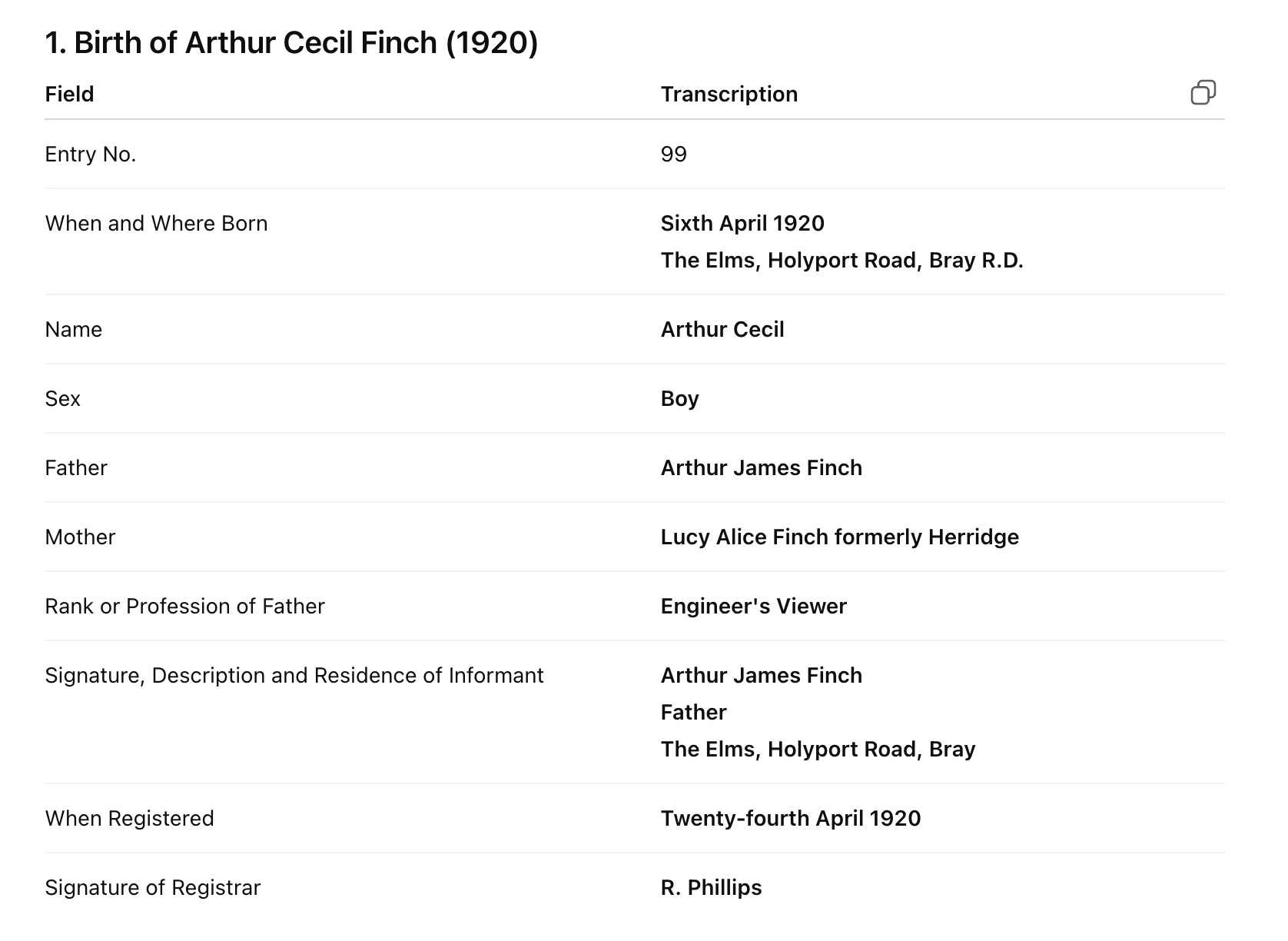
Arthur Cecil Finch was born on 6 April 1920 in Bray, Berkshire, England, the son of Arthur James Finch and Lucy Alice Finch, formerly Herridge.

1921 Census
Leonard Victor Finch
The 1921 Census provides the first confirmed record of Leonard Victor Finch living in Scotland. At seventeen years of age, Leonard was recorded as an inmate of the Edinburgh Home for Working Lads on Ponton Street, Edinburgh. Born in Chelmsford, Essex, he was living more than 350 miles from the town where he had spent his childhood.
The Edinburgh Home for Working Lads, formerly known as the Edinburgh Industrial Brigade Home, provided accommodation and support for young men who were entering employment. It offered a structured environment where residents could live while learning trades, earning wages, and establishing themselves in working life. The institution was not a prison or workhouse, but rather a supervised home intended to help young men become independent and self-supporting.
The census records Leonard's occupation as a Plumber, employed by Messrs James Thomson & Son, Plumbers. This is a particularly significant detail because it shows that by the age of seventeen he had already entered a skilled trade. Plumbing required technical knowledge, practical ability, and usually some form of apprenticeship or workplace training. Unlike many labouring occupations, it offered the prospect of long-term employment and advancement.
This is also the earliest known record linking Leonard to the profession that would remain associated with him throughout his adult life. Later records would continue to describe him as a plumber, suggesting that his training in Edinburgh provided the foundation for his future career.
What makes Leonard's appearance in the census particularly noteworthy is how unusual his circumstances were. The overwhelming majority of the home's residents had been born in Edinburgh, Midlothian, or neighbouring Scottish counties. Most were local young men who had travelled only a short distance from their birthplace.
Only a handful of residents had been born outside Scotland. Among the thirty-five young men listed on the census page, there was William Wilson Stenright from Northumberland and Edward Nicol, who had been born in Washington, United States of America. Leonard was the only resident born in Essex and one of very few who had travelled such a considerable distance to be there.
This absence of other boys from Essex is significant. It suggests there was no obvious formal link between the Edinburgh Home for Working Lads and charitable organisations in Chelmsford. Had there been an established arrangement, we might expect to find other young men from the south of England among the residents. Instead, Leonard appears to have arrived in Edinburgh through circumstances unique to his own family.
Those circumstances had been difficult. His father, William John Finch, died in 1907 when Leonard was only two years old. His mother, Alice Finch, died in 1917 when he was thirteen, leaving him effectively orphaned. By that time, many of his older siblings had already left home and established lives of their own.
One of those siblings was Arthur James Finch, who had moved to Scotland several years earlier. A valuation roll from 1915–1916 records Arthur living in Alexandria, Dunbartonshire, where he worked as a machinist. Although no surviving document has yet been found proving how Leonard came to Edinburgh, Arthur's presence in Scotland before their mother's death provides a plausible connection.
The Birth of Arthur Cecil Finch in 1920 shows the Arthur James Finch had returned to England post WWI.

William Finch
In 1921 William Finch was living in Chelmsford with his wife Beatrice Alice Finch, daughter Vira May Finch and a Boarder, John Gilmore Robinson.
Both William and the Boarder John are working for Marconi's Wireless Telegraph & Signal Company in Chelmsford.

George Ernst Finch
George Ernst Finch appears on the 1921 census living in Staines as a Boarder in the home of Stephen James Gorrod. Both George and James work for Laganda Ltd a car manufacturer later acquired by Aston Martin.

Lucy Alice Finch (wife of Arthur James Finch)
Lucy Alice Finch and her three children appear on the 1921 Census as visitors in her brother Frederick John Herridge's house, address 1 Railway Road, Newbury.
There is no reference to Arthur James Finch and he does not appear on the 1921 census in Scotland or England.

Emily Beatrice Finch and Christina Mabel Finch
Emily and Christina appear on the census together living at 15 Chaplin Road, Willesden both working as Men's Room Attendants. Both list their place of work as London General Omnibus, Omnibus Proprietors co, specifically at the Willesden Garage.

Ethel Alice Brown (nee Finch)
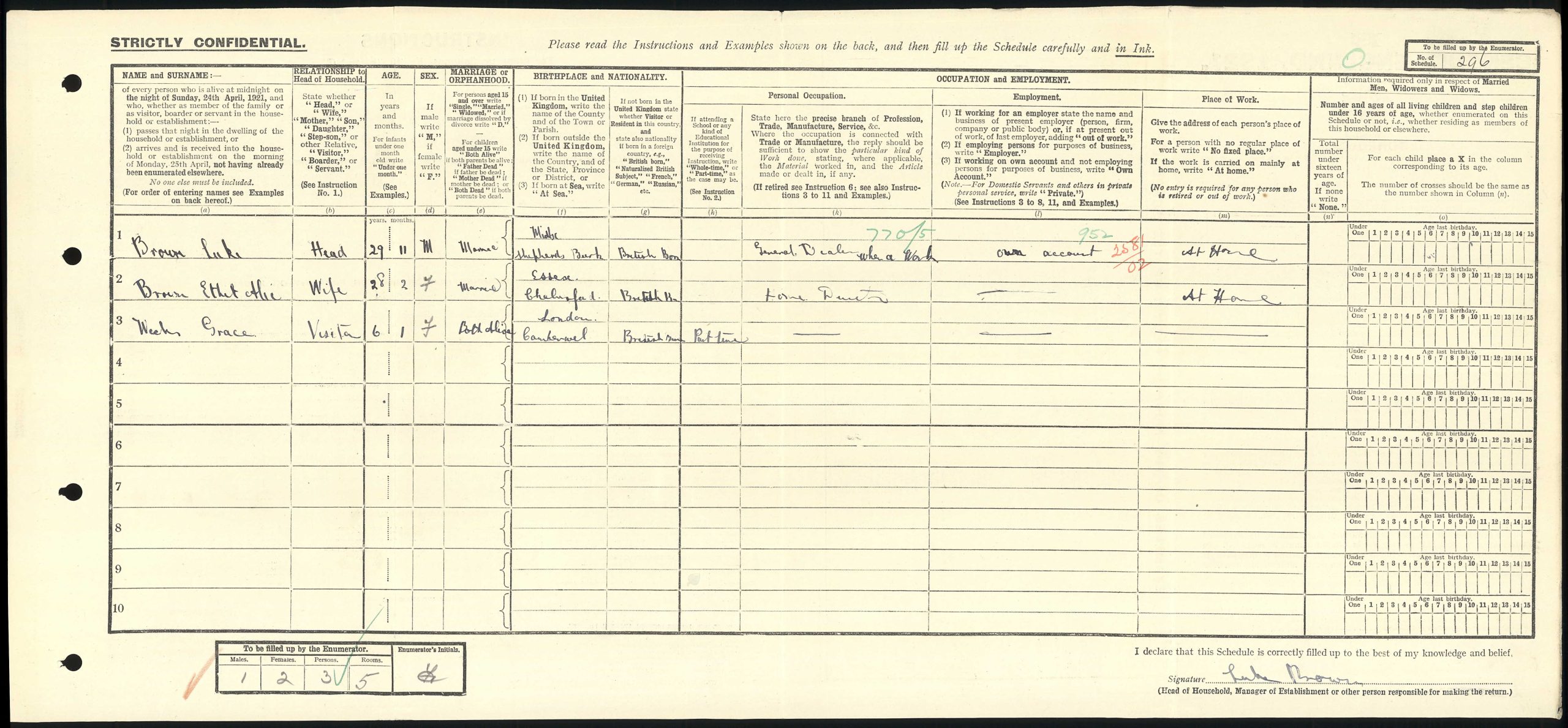
In the 1921 Census, Ethel Alice Brown, formerly Ethel Alice Finch, was recorded living at Station Road, Radlett, in the parish of Aldenham, Hertfordshire. She was listed as 28 years and 2 months old, married, British, and born in Essex, England. Her occupation was given as “home duties”, with her place of work recorded as “at home”, reflecting her role within the household after her marriage.
Ethel was living with her husband, Luke Brown, who was recorded as the head of the household. Luke was 29 years and 11 months old, born in Shepherd’s Bush, and working as a general dealer. The census suggests he was working on his own account, meaning he was self-employed rather than employed by a company. His place of work was also given as at home, which may indicate that the family’s home was connected to his trade or that his work was carried out from the household address.
Also present in the household was Grace Wicks, aged 6 years and 1 month, recorded as a visitor. She was born in Bankswell, London. Her exact relationship to Luke and Ethel is not stated in the census, but her presence suggests a family, friendship, or temporary caregiving connection.
The Edinburgh Industrial Brigade
In 1899 the building on Ponton Street that Leonard was living in was the 4th incarnation of the Edinburgh Inductial Brigade. Originating in Cockburn Street, then Leith Terrace and subsequently Grove Street. The completed building, designed by Frank W Simon cost £10,500 (£1.1 Million in 2024).
"On the Fountainbridge and Ponton Street frontage, it consisted of four storeys and basement, and towards Thorneybank of three storeys. The Fountainbridge frontage was faced with stone, and the other elevations with terracotta-facing bricks. The buildings were arranged around an open court to provide ample light and ventilation. The block facing Fountainbridge had a series of shops on its ground floor, on the first floor a directors' and ladies' room, and reading and play rooms for the boys."
Find out more at https://www.childrenshomes.org.uk/EdinburghIB/
What was the home like?
For the time the home was forward-thinking with a goal to educate young men with a trade. The location in Fountainbridge gave the young men easy access to industries of the day. It was in close proximity to Tanners, Slaughter Houses, Breweries as well as all the main trades.
The home was for boys aged 14 years and up, this would put Leonard in the right age range. His brother's job in munitions would have required skilled tradespeople from all main trades. It would not be outside the realms of possibility that Arthur James Finch was working with men who had been residents of the home.
The Edinburgh Industrial Brigade would have been luxurious when compared with the alternative Workhouses in Essex and London.
23 July 1906
The Dundee Evening Telegraph and Post
An article in the paper talks about about how 'boys' from the home had attended a camp in Dundee. It referred to the home as "the pioneer, and most important of its kind in Britain"

Another article from 1921 gives an operational overview of the home and a glimpse into how the home runs. It mentions the 100 boys in resident of which Leonard is one.


Photograph
This is the earliest known photo of Leonard Victor Finch, taken in approximately 1921. The image was taken at a Football Camp organised by the Edinburgh Industrial Brigade. Locations could be Gullane (East Lothian), Ladywell (Fife) or Bonaly (Edinburgh). According to various reports, these were the main locations the home-organised camps.


1925 -1927
Leonard appears on the Electoral Roll for 1925 and 1926 at the Edinburgh Industrial Brigade. The address on the roll is 1 Ponton Street, Edinburgh.
Leonard appears on the Electoral Roll for 1925 and 1926 at the Edinburgh Industrial Brigade. The address on the roll is 1 Ponton Street, Edinburgh.
In 1927 Leonard's address changed to 3 Freer Street, Edinburgh. Although Freer Street still exists today the buildings and structure of the street have completely changed.
Originally the Street consisted of large tenement buildings along with a social club for workers of the Scottish and Newcastle Brewery.
The back of Freer Street ran across the Union Canal

© Robert Blomfield Photo taken 1960
Below is a copy of the 1927 Electoral Roll for Freer Street and Freer Street Terrace. It shows Leonard along with Elizabeth and Robert Sutherland*.
This is the home of Leonard's future wife Rachel Burns Sutherland.
*The Robert Sutherland on the Roll could be Rachel Burn Sutherland's father or brother.

Marriage
Leonard Victor Finch married Rachel Burns Sutherland on the 21st of December 1929.

Leonard lists his address as 17 Downfield Place, Edinburgh and Rachel as 7 Wardlaw Street, Edinburgh. Their occupations are Plumber and Dairy Worker respectively.
Leonard records his father by his middle name 'John' Finch.
The 1929 Electoral Roll records both Rachel and Leonard as living at Freer Street. Possibly they had moved later in the year as their marriage was in December or they were using Freer Street as a permanent address.
Death of Luke Brown
On the 24 August 1936, Luke Brown (Huspand of Ethel ALice Brown nee Finch) dies, in Watford, Hertfordshire. Luke, who had been born in 1891, was only around 45 years old when he died. His death brought an early end to their married life, which had begun in June 1919, shortly after the First World War.
